Flow - Digital Banking & Crypto
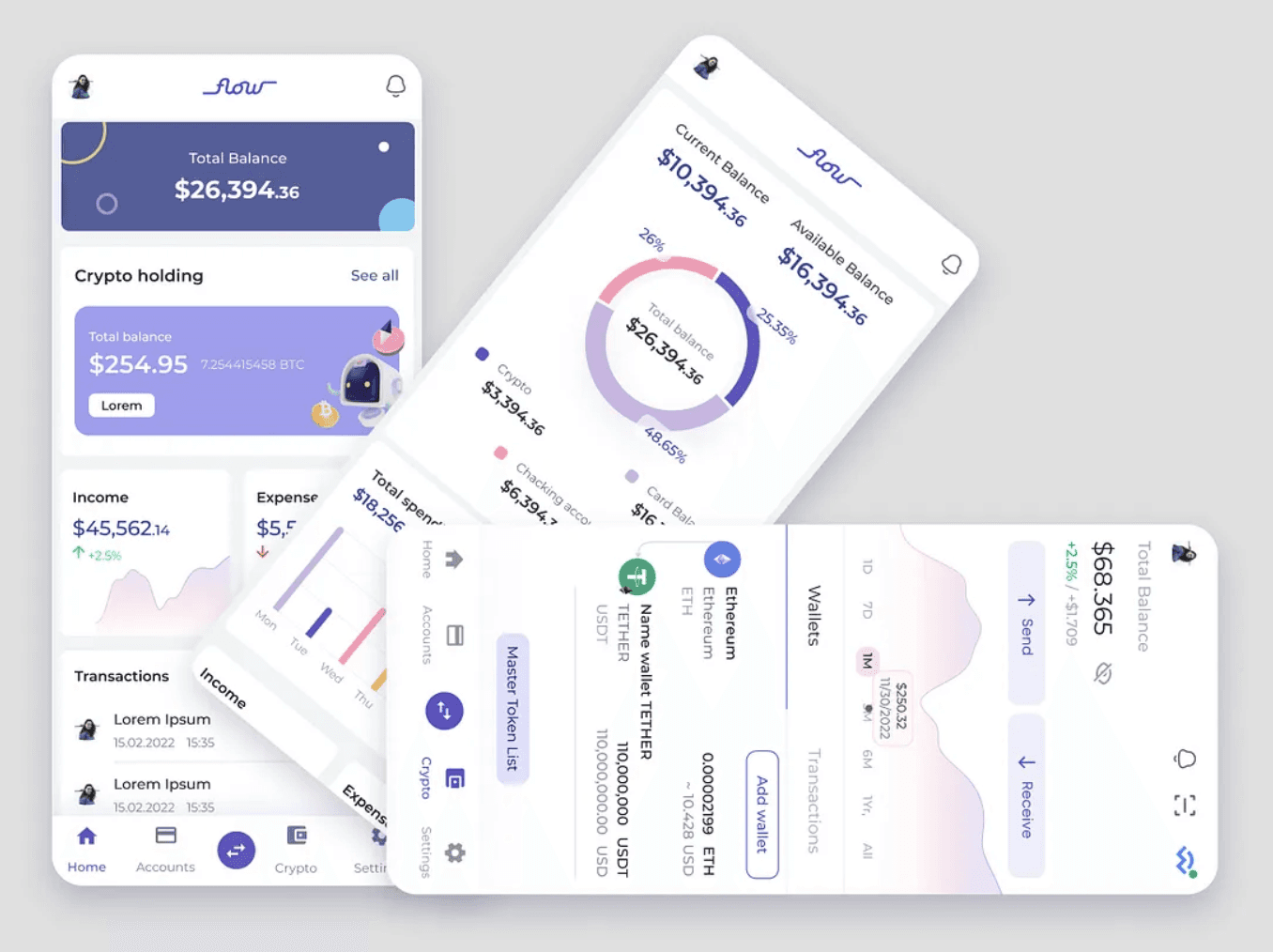
An integrated financial platform that brings digital banking and crypto assets into one ecosystem, enabling transparent transfers, clear asset visibility, and seamless financial control.
Structuring a Unified Financial Platform
Flow was designed to centralize traditional banking and crypto asset management within a single cohesive system. In a fast-growing startup environment, I led the end-to-end product design, defining how these two fundamentally different financial domains could coexist through a scalable architecture.
The platform enables users to manage assets, move funds between banking and crypto accounts, and maintain a clear financial overview without switching platforms.
Role: Solo Product Designer - I led the product design across banking and crypto modules, defining system architecture, core interaction flows, and the platform’s UI foundation.
Product: Neobank and Crypto Wallet in One Application - Neobank and crypto wallet in one application, allowing users to manage assets, convert funds, and perform transactions within a unified financial environment.
Scope:
• Defined the information architecture for banking and crypto modules
• Designed the core financial and transfer flows
• Established the UI system and reusable component library
• Structured interaction patterns across modules
• Led developer handoff and implementation alignment
Constraints:
• Fast-paced startup environment requiring rapid iteration
• Multiple financial domains with different behavioral models
• Payment module with predefined branding requirements
Deliverables:
• Banking and crypto home dashboards
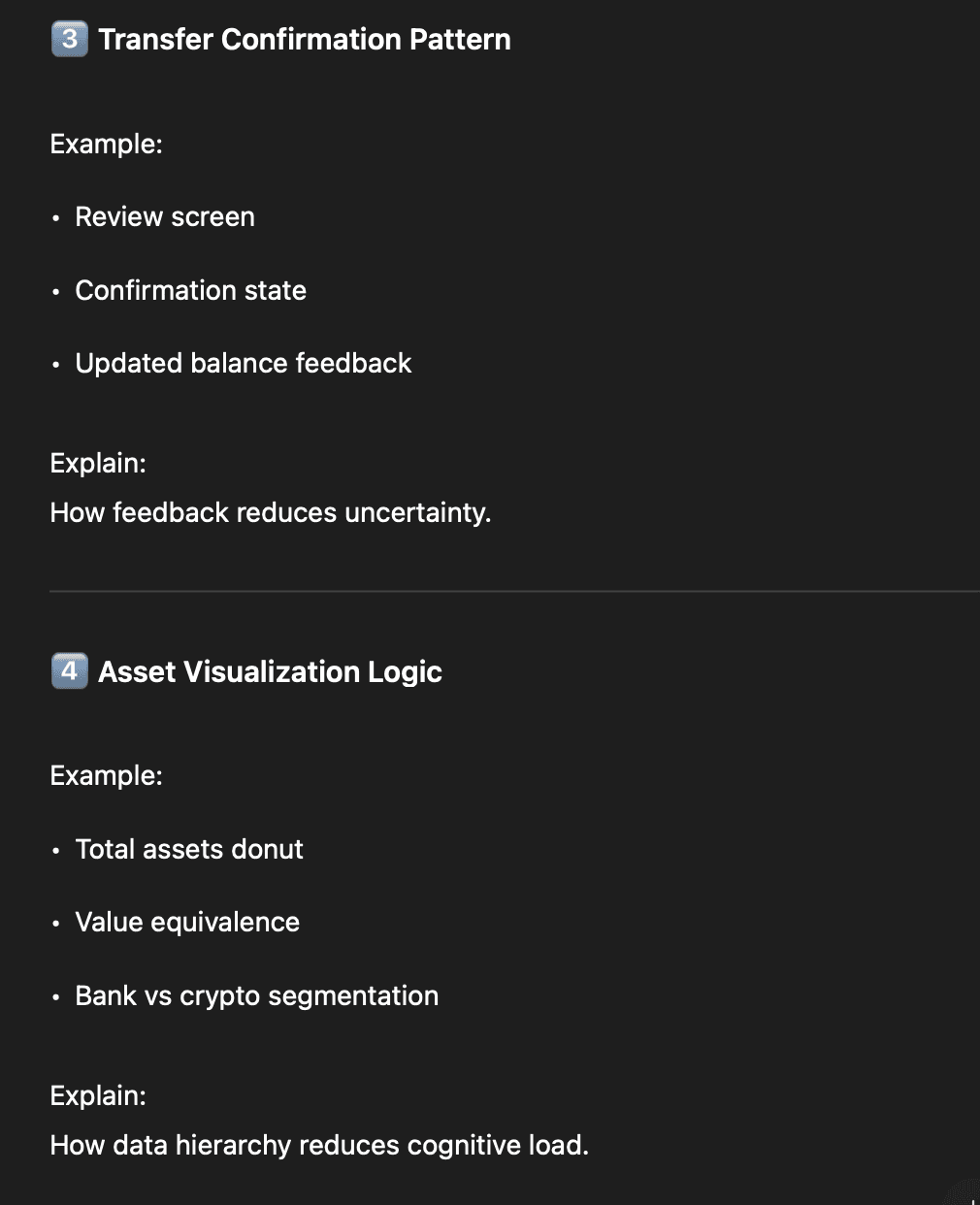
• Asset overview and portfolio visualization
• Internal transfer and conversion flows
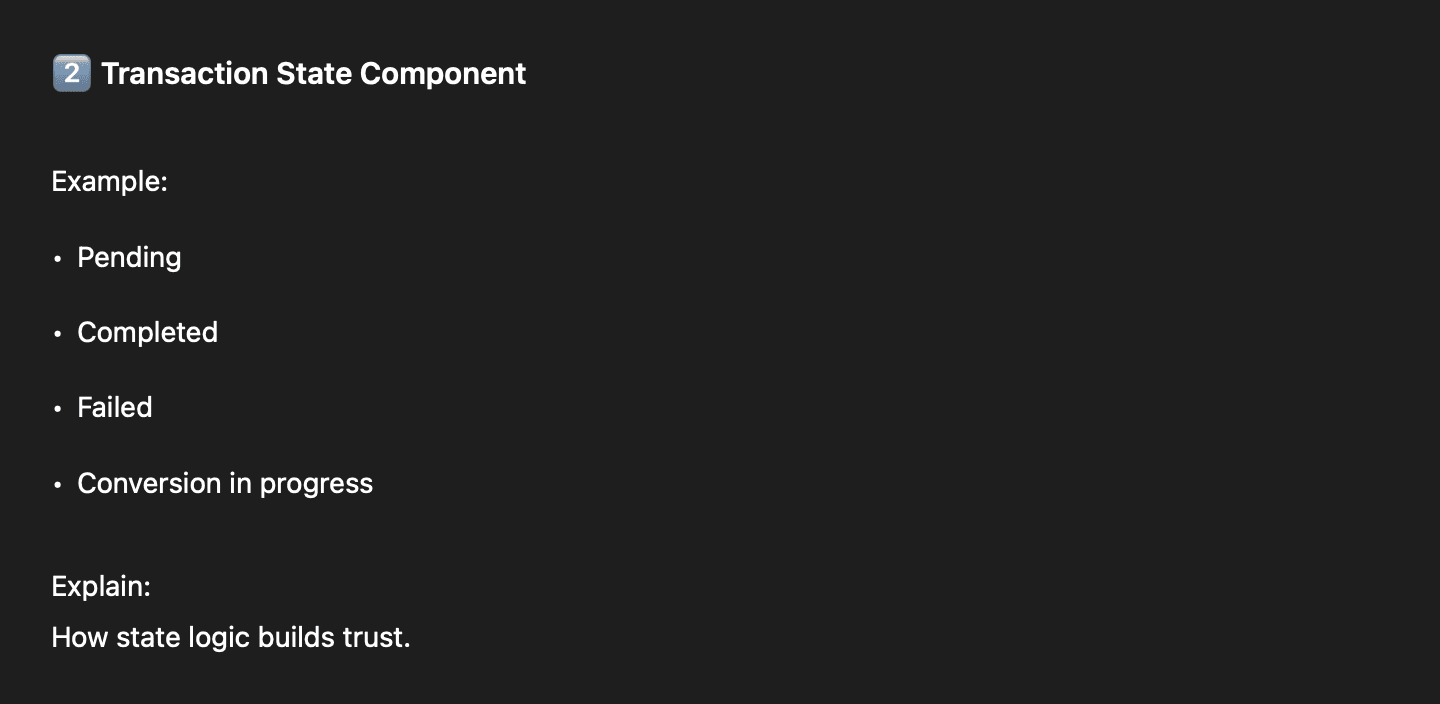
• Transaction states and feedback patterns
• UI direction and visual system refinement
When Banking and Crypto Operate in Silos
As digital finance evolved, users increasingly began managing their money across disconnected systems — traditional banks for everyday transactions and separate crypto platforms for digital assets.
This fragmentation created several structural issues:
• No unified view of total assets
• Friction when moving funds between banking and crypto platforms
• Inconsistent transaction logic across systems
• Increased cognitive load when tracking balances
• Reduced trust during conversions and transfers
Traditional banking and crypto operate under fundamentally different behavioral and technical models. Without a shared structure connecting these systems, users are forced to mentally reconcile their financial position across multiple platforms.
Structuring a Unified Financial Architecture
The challenge was not simply combining two dashboards into one interface.
It required designing a scalable system that could:
Integrate traditional banking stability with crypto volatility
Maintain clarity across fundamentally different asset behaviors
Provide transparent internal transfers without increasing friction
Align with predefined payment branding constraints
Support rapid iteration within a startup environment
This required designing at the system level, ensuring cohesion, trust, and technical feasibility across all modules.
Structuring a Cohesive Financial System
To support clarity and scalability, to support clarity and scalability, the platform was structured into four interconnected product layers.
|
|
|
|
|---|---|---|---|
Card overview | Wallet overview | Bank → Crypto conversion | Integrated utility & bill payment functionality |
Checking accounts | Asset breakdown with value equivalence | Crypto → Bank conversion | |
Transaction history | Send / Receive functionality | Clear confirmation states | |
Payment actions (Pay, Deposit, Transfer) | Portfolio visibility | Transparent balance updates | |
Scheduled and AutoPay functionality | Error prevention logic |
Designing the Core Financial Experience
To translate the system architecture into a usable product, the platform focuses on three key interaction patterns that support asset visibility, seamless transfers, and clear transaction feedback across banking and crypto modules.
Unified Asset Overview
Users needed a clear understanding of their financial position across both banking and crypto assets.
The platform introduces a consolidated dashboard where assets from different systems are presented within a single financial overview, reducing the need to reconcile balances across multiple platforms.

Internal Transfer System
Core Interaction Flow
The central system behavior:
Bank Account → Convert → Crypto Wallet → Track → Convert Back → Spend
This structured flow ensured:
Financial transparency
Reduced friction
Clear transaction feedback
Reinforced user trust
Designing Flow required architectural clarity across two financial domains. Key decisions included:
Module Separation with Shared Visibility: Banking and crypto were structured as distinct layers while maintaining a unified asset overview.
Transfer as Core Infrastructure: Internal conversion was designed as a primary system behavior, ensuring transparent states and balance updates.
Progressive Financial Disclosure: Complex data was layered to reduce cognitive load while preserving transparency.
System Cohesion Across Constraints: Interaction patterns and hierarchy were aligned across modules despite predefined payment branding.
"Image here"
Key User Flows - change title
1. Financial Overview
Home → Asset Summary → Account/Wallet Detail
Focus: unified visibility and clear financial hierarchy.
Internal Transfer
Bank ↔ Crypto → Amount → Review → Confirm
Focus: transparent conversion and trust during movement.
Asset Interaction
Wallet → Select Asset → Send / Receive
Focus: clarity, confirmation states, secure action flow.
Payments
Pay → Select Utility → Confirm → Transaction Update
Focus: predictability and structured transaction history.
I structured internal user flows across banking and crypto domains, ensuring consistent navigation logic and seamless financial movement between modules.
image wirefow:
Internal Transfer Flow (Hero Flow)
Banking Transaction Flow
Crypto Asset Flow
Establishing Cohesion Across Modules
As Flow evolved, the visual system required clarity between banking, crypto, and payment modules while preserving ecosystem cohesion.
Initial Direction
The first phase focused on:
Establishing foundational color tokens
Defining hierarchy across financial data
Creating consistent spacing and layout structure
Aligning interaction patterns with engineering feasibility
System Refinement
As the product matured, I led a refinement of the UI direction to:
Increase distinction between banking and crypto environments
Improve financial data readability
Strengthen trust through visual stability
Align predefined payment branding within a shared structural system
Rather than forcing visual uniformity, I ensured cohesion through:
Consistent layout logic
Unified component behavior
Structured typography hierarchy
Shared interaction states
Scalable UI Foundations

Enabling a Cohesive Financial Experience
By structuring Flow as a unified ecosystem rather than isolated features, the product achieved:
Clear cross-domain financial visibility
Seamless internal asset transfers
Consistent interaction patterns across modules
Reduced cognitive load in complex financial scenarios
A scalable foundation for continued product growth
The architectural separation combined with unified visibility ensured users could confidently navigate banking and crypto within one structured environment.
Designing Beyond Screens
This project strengthened my ability to design at the system level — aligning user behavior, technical constraints, and product scalability within a startup environment.
Key learnings:
Financial products demand clarity before creativity
Transfer states are trust-critical moments
Structural decisions impact long-term scalability more than visual styling
Cohesion can be achieved through interaction logic, not only visual uniformity
Flow reinforced the importance of architectural thinking in complex digital ecosystems.